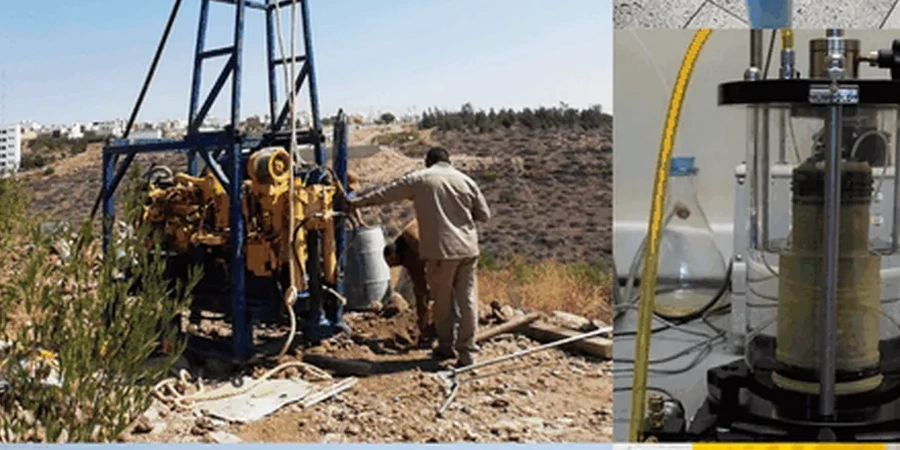
In Sault Ste. Marie, loose granular deposits left by glacial Lake Algonquin present a recurring challenge at shallow foundation depths. The terrain north of the St. Marys River often conceals sands and silty sands that, when saturated, exhibit low relative density well below the 70 percent threshold required for conventional footings. The vibrocompaction design approach here differs from southern Ontario precisely because the water table sits high and the overburden stress history is minimal. Before committing to a deep foundation scheme, the team evaluates whether the site stratigraphy can respond to deep vibratory densification, which regularly proves more economical than piling when the grain-size distribution falls within the treatable envelope. That evaluation draws on the grain size analysis to confirm less than 15 percent fines, and often benefits from a CPT test to map density profiles before and after treatment.
Achieving 85 percent relative density below the frost zone turns marginal waterfront fill into a competent bearing stratum.
Regional considerations
Sault Ste. Marie sits within the western Quebec seismic zone, where the 2010 Val-des-Bois earthquake — a magnitude 5.0 event felt across the region — reminded engineers that loose saturated sands can lose strength under cyclic loading. A vibrocompaction design that does not achieve the specified density leaves the site vulnerable to settlement during a moderate seismic event, even one centred in the Ottawa Valley. Beyond seismicity, the city’s industrial waterfront contains undocumented fill layers with slag, wood debris, and random boulders that can obstruct the vibrator and create untreated columns within the grid. The design must therefore include contingency for probe deviation, pre-drilling through obstacles, and a rigorous quality assurance protocol that correlates real-time ammeter readings with the compaction energy delivered at each penetration point.
Quick answers
What types of soil can be improved with vibrocompaction in Sault Ste. Marie?
The method works best on clean sands and gravels with fines content below 15 percent. The glacial outwash and shoreline deposits south of the airport typically respond well, while silty zones in the lower deltaic plain may require a different technique.
How is the compaction depth verified after treatment?
The design specifies overlapping verification through post-treatment SPT or CPT soundings at predetermined grid nodes. The results are compared against the baseline investigation log at the same location, and the improvement ratio is calculated across each 1.5-metre lift.
What does vibrocompaction design cost for a typical building lot in Sault Ste. Marie?
A complete design package including field trial, production drawings, and verification testing generally ranges from CA$2,100 to CA$7,580 depending on the treatment area, required probe depth, and number of verification points mandated by the geotechnical review.
How close to existing structures can vibrocompaction be performed?
The design sets a minimum standoff distance, usually 3 to 5 metres from sensitive foundations, based on peak particle velocity estimates. Vibration monitoring with seismographs is specified when working within 15 metres of occupied buildings to document compliance with Ontario vibration guidelines.