← Home · Laboratory

Laboratory CBR Testing in Sault Ste Marie

Together, we solve the challenges of tomorrow.

LEARN MORE →

Sault Ste Marie sits on a mix of glacial till, lacustrine clay, and silty sand deposits left by the retreat of the Lake Superior lobe. Compacted subgrade here has to handle freeze-thaw cycles that reach 1.8 m depth, plus summer humidity pushing moisture back into the formation. We run the California Bearing Ratio test inside a controlled soak tank that simulates four days of saturation, because the worst case for any pavement in the Soo is spring break-up. The plunger load is read at 2.54 mm and 5.08 mm penetration and compared against the standard crushed-stone reference. For granular base courses we often pair the CBR with a grain size analysis to confirm the gradation envelope before the soaked strength is recorded.

Soaked CBR in the Soo's silty clays can drop by half compared to as-compacted — the lab soak reveals what spring will do.
How we work

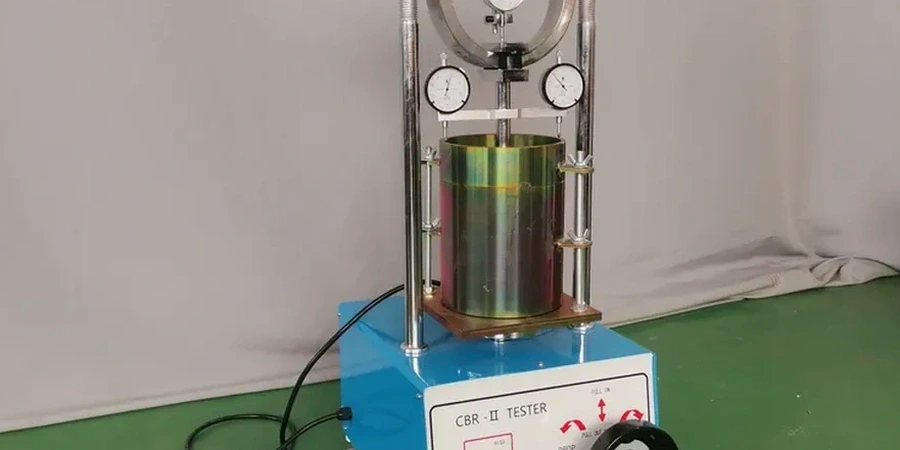
At an elevation of 192 m and with a metro population near 73,000, Sault Ste Marie deals with silty-clay subgrades that can drop below 3% CBR when saturated. Our laboratory CBR test follows CSA A23.3 and ASTM D1883 using a 50 kN load frame with a 1.27 mm/min strain rate. A 4.54 kg surcharge ring mimics the weight of the pavement structure itself, so the measurement reflects field confinement. We compact specimens at optimum moisture content from Modified Proctor energy, then soak them in water at 20°C for 96 hours. Swell is recorded daily with a tripod dial gauge. After soaking, the penetration test gives both CBR at 0.1 inch and 0.2 inch, and we report the higher value if it is consistent. Swell above 2% usually triggers a lime-stabilization recommendation.
Laboratory CBR Testing in Sault Ste Marie
Technical reference image — Sault Ste Marie

Local considerations

Our CBR load frame uses a calibrated proving ring and a linear variable displacement transducer that logs force versus penetration in real time. A bad specimen — one compacted 1% off optimum moisture or trimmed with a disturbed top surface — will read low and reject a perfectly good borrow source. We split the mold, inspect for layering, and weigh every specimen before and after soaking. Sault Ste Marie contractors occasionally bring us samples from road cuts near the St. Marys River where the water table sits less than a metre down; those clays swell 4–5% in the tank and the CBR can drop to 2. A pavement designed on an as-compacted number without soaking would rut by the second winter.

Need a geotechnical assessment?

Reply within 24h.

Email: info@geotechnicalengineering.vip

Technical parameters

ParameterTypical value
Standard followedASTM D1883 / CSA A23.3
Specimen compactionModified Proctor (ASTM D1557)
Soak duration96 hours in water at 20°C
Surcharge weight4.54 kg per specimen
Penetration rate1.27 mm/min
Measured valuesCBR at 2.54 mm and 5.08 mm, swell %
Typical local CBR range2–8% for native silty clay subgrade

Other technical services

01

Laboratory Soaked CBR

Full swell monitoring over 96 hours, penetration test at 1.27 mm/min, and report with corrected CBR values for subgrade and granular base.

02

Field CBR Correlation

We run laboratory CBR on Shelby tube samples taken from test pits or boreholes, then cross-check with DCP data to build a site-specific correlation for the Sault Ste Marie formation.

Reference standards

ASTM D1883 – Standard Test Method for California Bearing Ratio of Laboratory-Compacted Soils, CSA A23.3 – Design of Concrete Structures (referenced for pavement support requirements), ASTM D1557 – Modified Proctor Compaction Test, MTO LS-701 – Ontario Ministry of Transportation CBR method

Frequently asked questions

What does a laboratory CBR test cost in Sault Ste Marie?

A single-point soaked CBR test runs CA$170–CA$310 depending on whether we also run the companion Proctor compaction curve. A three-point set for a borrow-source evaluation falls in the same per-point range, with volume discounts available.

How long does the lab take to deliver results?

Five to seven business days. Four of those days are the mandatory soak period. We can send preliminary swell data after 48 hours if the contractor needs an early stabilization decision.

Why is the soaked CBR different from the unsoaked value?

Soaking for 96 hours saturates the soil and replicates the worst moisture condition under a pavement — typically spring thaw in Sault Ste Marie. Fine-grained soils lose significant strength when saturated, so the soaked CBR is the design value used in the Ontario MTO pavement thickness charts.

Location and service area

We serve projects in Sault Ste Marie and surrounding areas.

View larger map