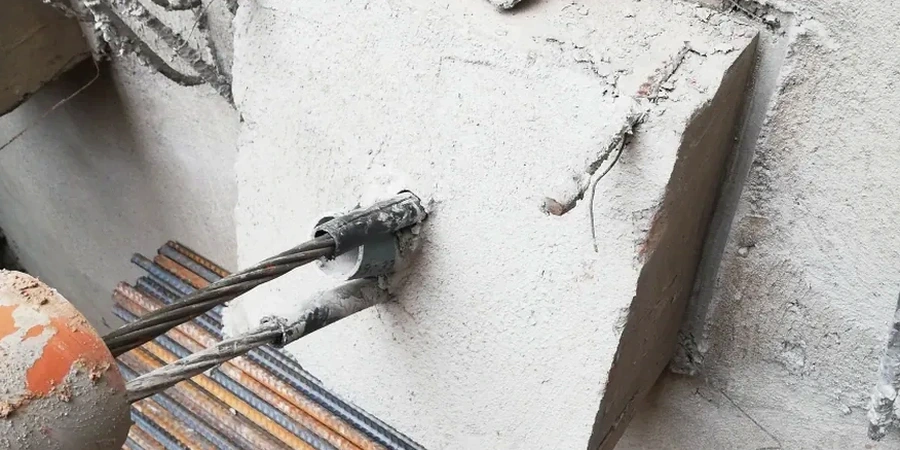
The transition from the rugged Canadian Shield outcrops north of Sault Ste Marie to the deep lacustrine clay deposits along the St. Marys River creates two very different anchoring challenges. On the high ground, you hit competent granitic gneiss within two metres; active tieback anchors here need to be short but work against a rigid mass. Down by the waterfront, where the post-glacial silty clay extends to depths of 12 metres or more, passive anchors in a cohesive soil demand a completely different load-transfer model. Our active/passive anchor design accounts for this sharp geological contrast using in-situ pull-out tests correlated with CPT test cone resistance data, ensuring every bonded length is verified against actual stratigraphy rather than assumed parameters.
Anchor capacity in the Soo is less about steel grade and more about where you seat the fixed length relative to the Precambrian contact.
How we work
A project near the International Bridge typically encounters dense basal till over limestone bedrock, while a site in the Bayview area deals with soft, compressible varved clay. The anchor design for the till site leans on high-strength passive grout bulbs keyed into the till's granular matrix, achieving bond stresses above 400 kPa. In the Bayview clay, we shift to active strand anchors with multiple bond zones, compensating for low undrained shear strength. Both scenarios are governed by CSA A23.3 steel stress limits and the NBCC frost penetration requirement that places the fixed length below the 1.8-metre frost line common to this latitude. Installation monitoring with load cells and dial gauges follows the testing schedule outlined in ASTM A416, adapted locally for Sault Ste Marie's seasonal temperature swings.
Regional considerations
The most common mistake we see in Sault Ste Marie is installing anchors with a fixed length that crosses the till-clay interface. When part of the bond zone sits in stiff till and part in soft clay, creep displacement concentrates in the weaker material, and the anchor loses prestress within months. We have pulled out failed anchors on King Street projects where the as-built log showed exactly this error: the contractor assumed uniform soil, but the varved clay was interbedded with silt seams. Our design protocol requires a minimum 1.5-metre standoff from any stratigraphic boundary, verified by continuous sampling. A second frequent error is under-estimating the free length's thermal expansion in active anchors: with Sault Ste Marie's -30°C winter low, an exposed steel strand can contract enough to add 15 kN of unintended load if not accounted for in the lock-off procedure.
Quick answers
What is the difference between active and passive anchors for a retaining wall in Sault Ste Marie?
Active anchors are tensioned during installation to apply a pre-calculated force against the wall before excavation proceeds; this limits wall deflection from the start. Passive anchors develop resistance as the wall moves and the ground deforms. In Sault Ste Marie's stiff till, active anchors allow tighter control of adjacent settlement—critical near the historic canal infrastructure. In the Shield rock, passive rock dowels are often sufficient and more economical since rock mass deformation is minimal.
How deep must the fixed anchor length be to avoid frost effects in Sault Ste Marie?
The NBCC specifies a frost penetration depth of 1.8 metres for the Sault Ste Marie region. The unbonded free length must extend below this elevation, with the bonded zone starting at least 2.0 metres below finished grade. In practice, we specify a minimum 2.5-metre depth to the top of the bond zone to account for local microclimate effects near the lake.
What does active/passive anchor design and testing cost for a typical excavation?
A full anchor design package including site investigation, design calculations, construction specifications, and on-site proof testing typically ranges from CA$1,470 to CA$4,880 depending on the number of anchor rows and the complexity of the stratigraphy. A single-row wall with 15 anchors in uniform till falls at the lower end; a multi-level anchored system in varved clay with creep testing requirements falls at the upper end.