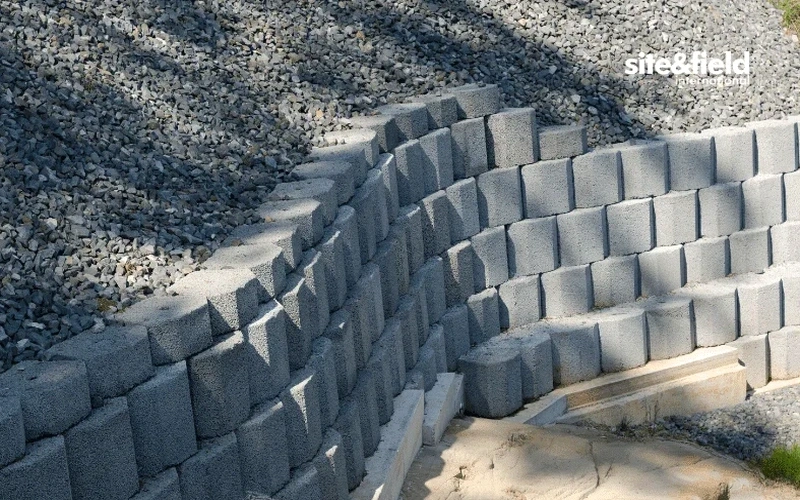
The freeze-thaw cycles hitting Sault Ste Marie are no joke—anyone who’s lived through a winter here knows the ground doesn’t just freeze, it heaves. Designing a retaining wall in this city means accounting for the silty sands perched over the Canadian Shield, where drainage can be terrible and frost penetration routinely exceeds 1.5 meters. Our team approaches each retaining wall design with borehole data from the actual site, not just regional maps. We tie everything back to the slope stability analysis when the wall sits near the St. Marys River escarpment, and we run grain-size distributions on every sample to confirm the backfill won’t trap water behind the stem. The geology here—thin drift over bedrock—demands a foundation check that most generic designs miss entirely.
A retaining wall in Northern Ontario fails from water behind it, not from the soil in front—control the drainage, control the design life.
Regional considerations
Under NBCC 2015, Sault Ste Marie falls into a moderate seismic zone with a spectral acceleration Sa(0.2) of 0.033—low by global standards, but enough to trigger the stability checks in CSA A23.3 for reinforced concrete walls. The bigger risk here is not earthquakes, it’s seasonal saturation and frost jacking of the footing. When a retaining wall is constructed without a positive drainage blanket, the cyclic freeze-thaw of a Sault winter can lift the heel incrementally each year until the wall tilts forward. We’ve seen this failure mode in older gabion walls near the waterfront. To prevent it, our designs always include a minimum embedment depth below the local frost line, verified by in-situ permeability testing of the foundation stratum—if the soil can’t drain, we extend the gravel layer under the entire footprint of the wall.
Quick answers
What type of retaining wall works best in Sault Ste Marie’s silty soils?
In the silty tills common across the city, a gravity wall or a reinforced concrete cantilever wall with an extended heel works well, provided the backfill is replaced with free-draining granular material. We avoid reinforced earth walls with metallic strips unless the electrochemical resistivity of the fill passes CSA A23.3 durability limits—some of the local till is slightly acidic and can accelerate corrosion.
How much does retaining wall design cost in Sault Ste Marie?
A complete design package—including site investigation, laboratory testing, and stamped drawings—ranges from CA$1,570 to CA$4,900 depending on wall height, length, and the number of boreholes required. Taller walls over 3 meters or those supporting roadway surcharge loadings fall toward the upper end of that range.
Do I need a geotechnical investigation if the wall is under 1 meter high?
Even for low walls, the Ontario Building Code expects the designer to confirm foundation conditions. A hand-augered test pit and a simple pocket penetrometer reading might suffice for a small garden wall, but any retaining wall holding back a public right-of-way or supporting a driveway should have at least one machine-excavated test pit logged by a geotechnical engineer to rule out buried organics or soft clay seams.