← Home · Roadway

Flexible Pavement Design for Northern Ontario’s Climate Extremes

Together, we solve the challenges of tomorrow.

LEARN MORE →

The expansion of Sault Ste. Marie from a fur trading post into a steel and forestry hub left a legacy of industrial haul routes that now underpin the city’s commercial corridors. Designing a flexible pavement system here means contending with more than just traffic loads; the underlying glaciolacustrine clays and silts deposited by the retreat of Lake Algonquin demand a structural section that can resist both spring thaw weakening and the 280 cm of annual snowfall. Our team approaches each flexible pavement design in Sault Ste. Marie by first quantifying the subgrade’s sensitivity to moisture, because a pavement that performs through a −30°C January must still shed meltwater effectively in April without rutting. When the project corridor crosses variable fill, we integrate findings from in-situ permeability testing to calibrate the drainage layer, ensuring the granular base remains free-draining even under the prolonged wetting-drying cycles typical of the St. Marys River watershed.

In Sault Ste. Marie, the difference between a 15-year and a 25-year pavement life often comes down to how well you manage the capillary rise through the subbase during March.

How we work

One thing you learn quickly working on flexible pavement design in Sault Ste. Marie is that the standard Ontario Ministry of Transportation granular base gradations often need adjustment once you hit the silty tills prevalent north of the city. We routinely see base course materials that meet spec in the stockpile but lose permeability after compaction because of fines migration from the subgrade — a condition that only reveals itself after the first full freeze-thaw season. To address this, our methodology pairs ASTM D1883 CBR testing on soaked specimens with resilient modulus back-calculation from Falling Weight Deflectometer data, giving us a mechanistic-empirical pavement response that accounts for the seasonal stiffness loss. For industrial yards and intermodal facilities near the Essar Steel site, we also correlate the structural number with plate load test results to verify the in-situ modulus of the compacted layers before placing the asphalt concrete, reducing the risk of premature fatigue cracking under heavy forklift and container-handler traffic.
Flexible Pavement Design for Northern Ontario’s Climate Extremes
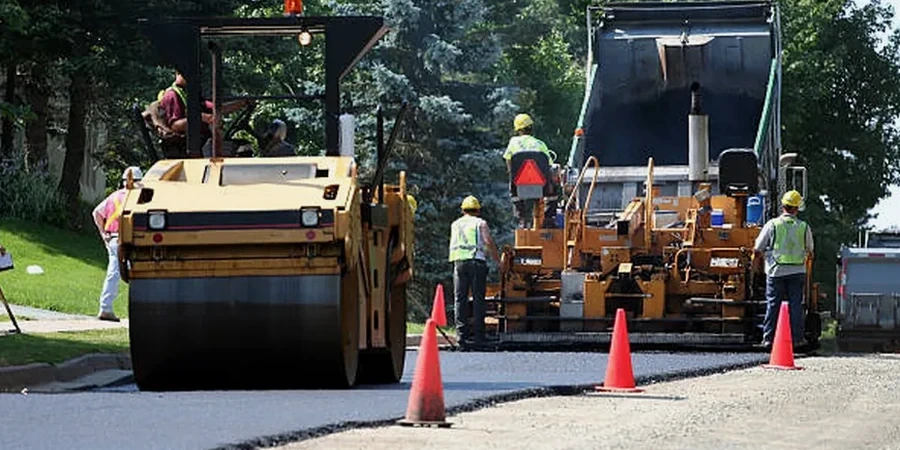
Technical reference image — Sault Ste Marie

Local considerations

At an elevation of roughly 190 m above sea level and with a frost penetration that can reach 2.1 m during the harshest winters, Sault Ste. Marie subjects flexible pavements to some of the most aggressive freeze-thaw attack in Ontario. The city’s 72,000 residents depend on arterial roads that must stay operational through lake-effect snow squalls, yet the real structural threat develops quietly at the subgrade interface where ice lenses grow and subsequently collapse. A flexible pavement design that underestimates the local frost-susceptibility classification risks differential heave exceeding 40 mm, which manifests as alligator cracking within the first three spring cycles. Even well-graded crushed stone loses its load-spreading capacity when the underlying silt becomes saturated, a scenario we mitigate by specifying separation geotextiles confirmed through grain size analysis and by extending the granular base thickness beyond the minimum OPSS requirements for areas mapped as high-groundwater zones within the Great Lakes–St. Lawrence Lowland physiographic region.

Need a geotechnical assessment?

Reply within 24h.

Email: info@geotechnicalengineering.vip

Technical parameters

ParameterTypical value
Design methodAASHTO 93 / Mechanistic-Empirical (MEPDG)
Subgrade evaluationASTM D1883 (CBR), resilient modulus (Mr)
Base courseGranular A/B (OPSS 1010), permeability ≥ 150 m/day
Asphalt layersSuperpave PG 58-34 or PG 64-28 binder grades
Frost protectionTotal pavement thickness ≥ 80% of frost depth
Typical design ESALs0.5 to 10 million (municipal to arterial)
Drainage coefficient (Cd)0.80–1.00 depending on saturation exposure

Other technical services

01

Mechanistic-Empirical Pavement Design

Full MEPDG analysis incorporating Sault-specific climate data, traffic spectra, and subgrade resilient modulus to optimize layer thicknesses and forecast distress.

02

Subgrade Stabilization and Improvement

Chemical stabilization with lime or cement for the high-plasticity clays found in the Sault basin, verified through UCS and durability testing per ASTM procedures.

03

Falling Weight Deflectometer (FWD) Evaluation

Non-destructive structural capacity assessment of existing pavements, back-calculating layer moduli to identify weak zones before overlay design.

04

Construction QA/QC and Field Density Control

Nuclear gauge and sand cone density testing during placement of granular and asphalt layers, ensuring compaction meets the specified 98% modified Proctor.

Reference standards

ASTM D1883 – Standard Test Method for California Bearing Ratio (CBR) of Laboratory-Compacted Soils, AASHTO Guide for Design of Pavement Structures (1993, with Ontario supplements), CSA A23.1/A23.2 – Concrete Materials and Methods of Concrete Construction (for rigid tie-ins), OPSS 1010 – Material Specification for Aggregates: Base, Subbase, Select Subgrade, and Backfill Material, NBCC 2015 – National Building Code of Canada (structural references for pavement loading)

Frequently asked questions

What is the typical cost range for a flexible pavement design package in Sault Ste. Marie?

A complete flexible pavement design package for a municipal or commercial project in Sault Ste. Marie, including subgrade investigation, traffic analysis, MEPDG design, and construction specifications, typically ranges from CA$2,330 to CA$6,090 depending on the project length, number of borings, and whether FWD verification is included.

How does the local frost depth affect the pavement structural number?

In Sault Ste. Marie, the design frost depth often exceeds 2.0 m, which directly governs the minimum total pavement thickness. We apply a frost protection criterion requiring the combined asphalt and granular thickness to reach at least 80% of the design frost depth, and we select base materials with less than 5% passing the 0.075 mm sieve to prevent capillary rise and ice lens formation.

Which asphalt binder grade do you specify for roads in Sault Ste. Marie?

For most municipal and arterial roads in Sault Ste. Marie, we specify Superpave PG 58-34 to handle the low-temperature cracking resistance needed in the Algoma climate. For high-stress intersections or industrial yards with slow-moving heavy loads, we may upgrade to PG 64-28 to gain better rutting resistance during the summer months while still maintaining cold-weather flexibility.

Can you design flexible pavements for heavy industrial traffic at the steel plant or port?

Yes. For industrial pavements like those serving the Algoma Steel site or the Port of Algoma intermodal area, we design using AASHTO 93 supplemented by finite-element analysis for concentrated wheel loads. We account for static loads from laden container handlers, channelized traffic patterns, and potential fuel or chemical spills by selecting polymer-modified binders and increasing the base course thickness beyond typical highway standards.
Location and service area

We serve projects in Sault Ste Marie and surrounding areas.

View larger map