Geotechnical Engineering in Sault Ste Marie

Together, we solve the challenges of tomorrow.

LEARN MORE →

The heavy clays deposited by the glacial Lake Algonquin define subsurface behavior in Sault Ste. Marie. Anyone breaking ground on the Precambrian fringe quickly discovers that what looks like stable terrain can hide compressible silt lenses twenty meters deep. The soil mechanics study we run here focuses on that contrast: the stiff till cap and the soft lacustrine sediment beneath it. A foundation designed for Windsor won't perform the same way on the north shore of the St. Marys River. Seasonal saturation cycles, freeze-thaw depth reaching two meters, and the proximity of the shield rock all demand a site-specific geotechnical profile. We process Shelby tube samples and remolded specimens to deliver shear strength parameters and consolidation curves that the structural engineer can use directly in the NBCC load and resistance factor design.

Varved clay from the Sault plain can lose half its shear strength when remolded — sensitivity ratios above 8 are common.
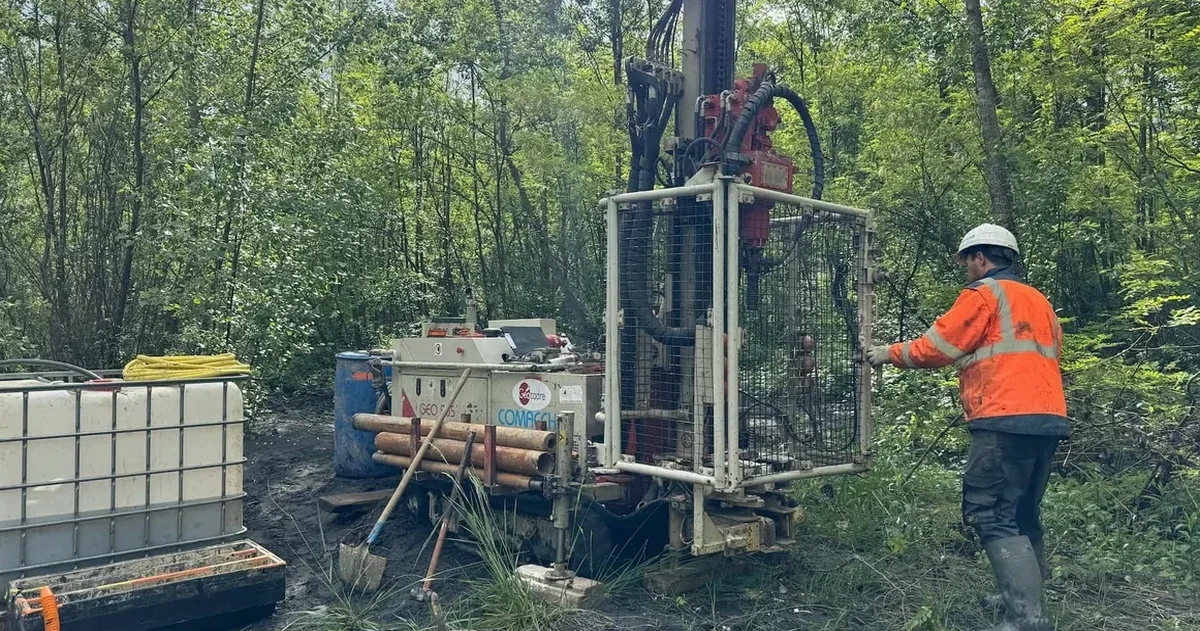
Geotechnical Engineering in Sault Ste Marie
Technical reference image — Sault Ste Marie

How we work

The native stratigraphy around the Sault is a layered sequence of varved clay, silty sand, and occasional boulder pavement resting on Archean granite. The water table often sits less than three meters below grade in the floodplain neighborhoods west of the canal. These conditions make a soil mechanics study essential for predicting differential settlement and lateral earth pressure. Our laboratory runs consolidated-undrained triaxial tests with pore pressure measurement, incremental oedometer loading per ASTM D2435, and Atterberg limit determination on every distinct stratum recovered. The varved clay, with its alternating silt-clay laminae, behaves anisotropically under load. In one recent project near Fort Creek, the upper crust showed an overconsolidation ratio above 4, but the underlying grey clay dropped below 1.5 within a meter — a profile that demands careful modulus selection. We complement the triaxial data with a grain-size analysis to quantify the silt fraction that governs drainage behavior during consolidation.

Local considerations

Part 4 of the Ontario Building Code, referencing the NBCC, classifies much of the St. Marys River lowland as a site where seismic soil-structure interaction must be checked. Sault Ste. Marie sits in the western Quebec seismic zone, with a 2% in 50-year peak ground acceleration near 0.12 g. On soft clay profiles, this modest acceleration amplifies the spectral response at periods matching mid-rise buildings. A soil mechanics study that skips dynamic property evaluation — shear wave velocity and modulus degradation curves — leaves the structural model incomplete. The biggest cost overruns we see stem from undetected sensitive clay layers that lose bearing capacity during excavation or from fill placement that triggers undrained creep in the underlying silt.

Need a geotechnical assessment?

Reply within 24h.

Email: info@geotechnicalengineering.vip

Technical parameters

ParameterTypical value
Undrained shear strength (Su)20 to 90 kPa (varved clay)
Compression index (Cc)0.15 to 0.45
Recompression index (Cr)0.02 to 0.06
Preconsolidation pressure (Pc)80 to 350 kPa
Saturated unit weight17.5 to 20.5 kN/m³
Liquidity index range0.3 to 1.2
Sensitivity (St)4 to 12 (varved clay)

Other technical services

01

Strength and Consolidation Testing

Triaxial CIU and CAU suites with pore pressure measurement, plus incremental oedometer loading to define Pc, Cc, Cr, and cv for each compressible layer.

02

Index Property and Classification Program

Full Atterberg limits, hydrometer grain-size distribution, natural moisture content, and unit weight determination on undisturbed Shelby tube specimens.

03

Interpretative Geotechnical Report

A signed, sealed report with bearing capacity recommendations, settlement versus time curves, liquefaction screening, and NBCC-compliant seismic site classification.

Reference standards

NBCC 2020 (National Building Code of Canada), CSA A23.3:19 (Design of Concrete Structures), ASTM D4767 (Consolidated-Undrained Triaxial), ASTM D2435 (One-Dimensional Consolidation), ASTM D4318 (Atterberg Limits)

Frequently asked questions

How much does a soil mechanics study cost for a lot in Sault Ste. Marie?

For a typical residential or light commercial parcel on the Ontario side, the laboratory testing and engineering report usually range between CA$3.710 and CA$6.280, depending on the number of boreholes and the triaxial suite required.

How deep do you need to investigate for a foundation on varved clay?

We typically extend the investigation to a depth where the stress increase from the footing drops below 10% of the in-situ effective stress. In the Sault clay plain, that often means continuous sampling to 15 or 20 meters below grade, reaching the competent till or bedrock interface.

Can you estimate settlement before the structural design is finalized?

Yes. With the consolidation parameters from the oedometer tests, we calculate immediate and primary consolidation settlement for several footing geometries and pressure ranges. The report includes settlement-versus-time curves so the design team can evaluate tolerances early in the project.

Location and service area

We serve projects in Sault Ste Marie and surrounding areas.

View larger map