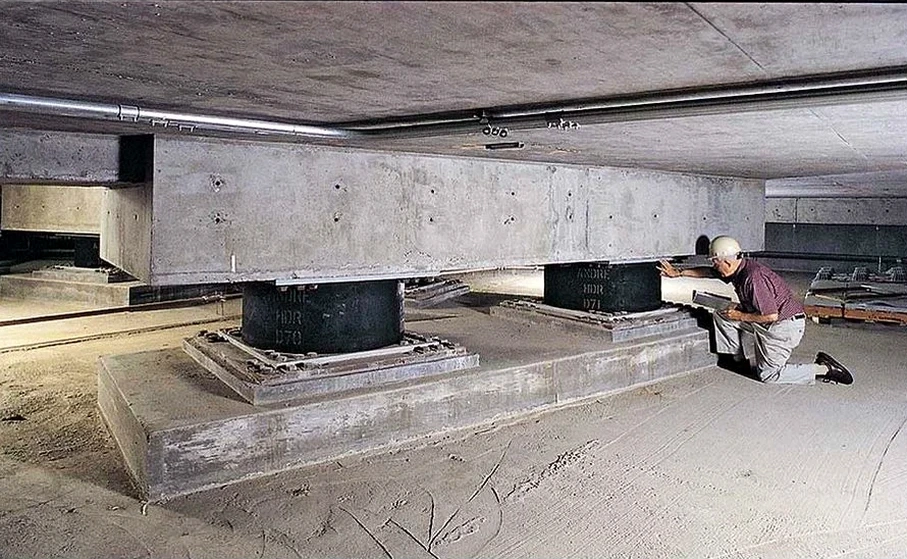
Sault Ste Marie sits in a region of moderate seismicity within the Great Lakes tectonic zone, yet the city's underlying geology—dominantly Precambrian Shield bedrock overlain by variable glacial till and lacustrine clays—creates specific challenges that standard fixed-base construction often fails to address. The 2010 magnitude 5.0 earthquake near Val-des-Bois reminded Ontario engineers that intraplate events, while less frequent, can generate ground motions that resonate unpredictably through stiff clay basins. When designing critical infrastructure or high-occupancy buildings in the Sault, relying solely on ductility-based detailing ignores the substantial drift and acceleration amplification that occurs when a structure's fundamental period matches the site's response spectrum. Integrating a seismic microzonation study early in the design phase provides the site-specific spectral ordinates necessary to calibrate an isolator system that decouples the superstructure from ground motion, rather than merely resisting it.
Effective isolation shifts the structural period beyond the site's predominant spectral peak, but only when the geotechnical profile is characterized to at least twice the isolator's effective diameter.
Reference standards
NBCC 2020 (National Building Code of Canada) — Part 4 Structural Design, Commentary J for seismic isolation, CSA A23.3-19 — Design of Concrete Structures, Section 21 for special seismic provisions, CSA S16-19 — Design of Steel Structures, Clause 27 for ductile seismic design, ASTM D4015 — Standard Test Methods for Modulus and Damping of Soils by Resonant-Column Method
Quick answers
What is the typical cost range for base isolation seismic design on a mid-rise building in Sault Ste Marie?
For a 4 to 6-story institutional or commercial building, the complete isolation design package—including site-specific hazard analysis, nonlinear time-history modeling, isolator specification, and peer review documentation—typically ranges from CA$6,450 to CA$12,340. The variation depends on the complexity of the superstructure, the number of ground motion suites required, and whether a full 3D soil-structure-interaction model is warranted by the geotechnical conditions.
How does the NBCC 2020 treat base isolation differently from conventional seismic force-resisting systems?
NBCC 2020, through its Commentary J, permits a reduction in design base shear for isolated structures because the fundamental period shift reduces spectral acceleration demand. The code requires two levels of analysis: a response spectrum analysis for the design basis earthquake and a nonlinear time-history analysis for the maximum considered earthquake. The isolation system must be tested to verify that its properties remain within the bounding values used in analysis, and the superstructure is designed for the reduced forces with an importance factor appropriate to the occupancy category.
What geotechnical parameters most influence the isolator design in Sault Ste Marie's soil conditions?
The shear wave velocity profile of the upper 30 meters (Vs30) governs site classification per NBCC Table 4.1.8.4.A, which directly modifies the design spectrum. In Sault Ste Marie, the contact between glacial till and bedrock often creates a strong impedance contrast that amplifies short-period motion. We also require the undrained shear strength of any clay layers beneath the isolator pedestals to assess bearing capacity under eccentric seismic loading, and the dynamic shear modulus and damping ratio at strains representative of the MCE event to properly model radiation damping into the soil half-space.