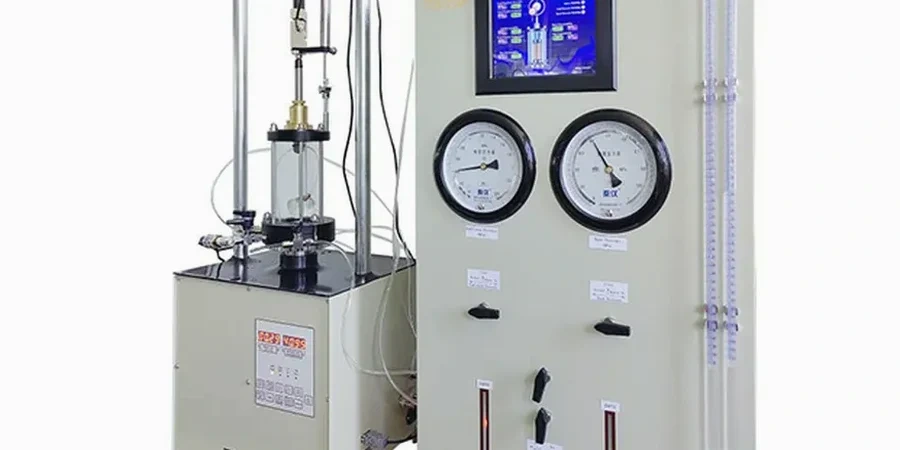
Sault Ste. Marie sits at 46.51°N, where frost can reach 2.4 meters down. That changes everything about soil strength. A standard unconfined compression test won't tell you what happens when the ground freezes, thaws, and gets loaded again. We run consolidated undrained and drained triaxial tests right here for local projects. The International Bridge plaza expansion taught us that Lake Superior clay needs full stress-path testing. Contractors working near the St. Marys River or up toward Hiawatha Highlands deal with complex overburden. A CPT test gives you a continuous profile, but only the triaxial cell reveals effective friction angle under the actual confining pressures your footing will see.
Effective stress parameters from a triaxial cell are the difference between a foundation that settles 12 mm and one that settles 50 mm.
Reference standards
ASTM D4767 - Consolidated Undrained Triaxial Compression Test for Cohesive Soils, ASTM D7181 - Consolidated Drained Triaxial Compression Test for Soils, CSA A23.3 - Design of Concrete Structures (references shear strength for foundation design), NBCC 2020 - National Building Code of Canada, Division B, Section 4.2
Quick answers
What does a triaxial test cost in Sault Ste. Marie?
A set of three CU triaxial tests typically ranges from CA$2,340 to CA$3,370, depending on specimen preparation complexity and whether we need to extrude Shelby tubes. Drained tests run slightly higher due to the longer shear stage. We carry out a firm quote after seeing the soil description and sample condition.
How long does a triaxial test take?
A CU triaxial set takes 5 to 7 business days from sample receipt to report. Saturation can take 24-48 hours for plastic clay. The shear stage itself runs 6 to 12 hours per specimen. Drained tests on silt take longer because the shear rate must be slow enough to prevent pore pressure buildup.
Do you need undisturbed samples for triaxial testing?
Yes. We need Shelby tube samples or block samples with minimal disturbance. The specimen is trimmed by hand in the lab using a wire saw and trimming lathe. Disturbed samples from split spoon or auger cuttings cannot be used for shear strength testing because the in-situ structure is destroyed.
What confining pressure should I specify?
Tell us the foundation depth and groundwater level. We calculate the effective overburden pressure and run confining stresses at 1x, 2x, and 3x that value. For a footing at 3 meters depth in Sault Ste. Marie clay with GWT at 1.5 m, typical confining pressures are 50, 100, and 200 kPa.
Can you test granular soils in the triaxial cell?
Yes, but the sample preparation is different. We use moist tamping or water pluviation to reconstitute sand specimens to the target density. The membrane is seated with vacuum before the cell is filled. We run CD tests on sand for effective friction angle at the density specified.