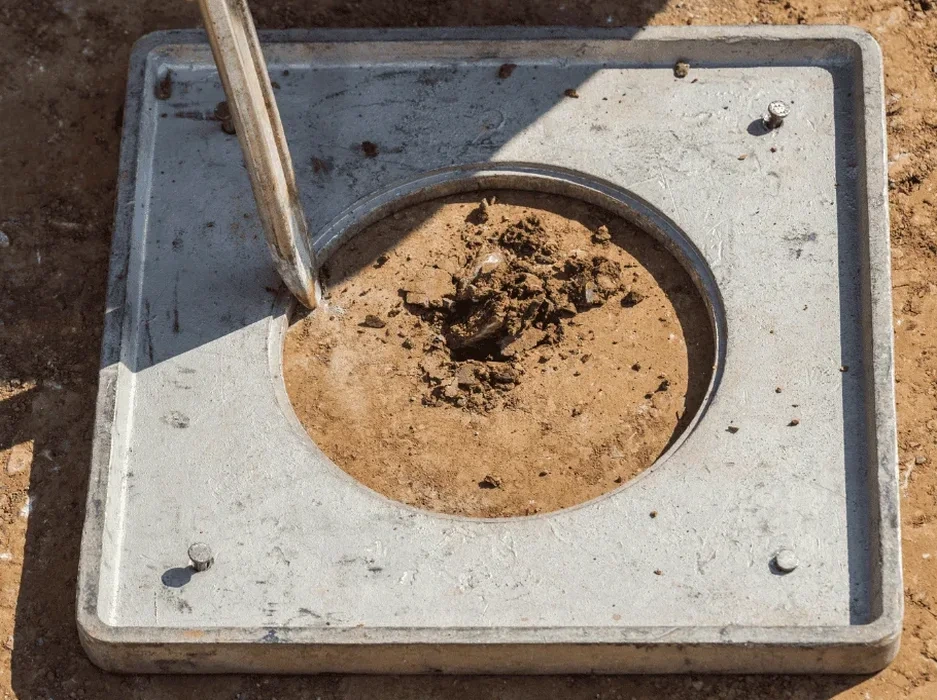
In Sault Ste Marie, a city spread across the former glacial spillway between Lake Superior and Lake Huron, the subsurface often surprises you. You hit clean sand at four meters, then silt with wood fragments, then more sand—classic deltaic layering. Our lab team runs soil liquefaction analysis on samples taken from these exact deposits. A standard SPT alone does not answer the cyclic mobility question here. We push undisturbed Shelby tubes through the critical zone, measure fines content via the grain size analysis in our lab, and feed those numbers directly into the Seed-Idriss simplified procedure, adjusted for the local seismicity expected in the Algoma District.
Liquefaction here is not a generic risk—it is concentrated in the saturated, loose sands of the St. Marys River paleochannels.
Quick answers
What soil types in Sault Ste Marie are most susceptible to liquefaction?
Clean, loose, saturated fine-to-medium sands are the most susceptible. In Sault Ste Marie, these appear in the floodplains of Fort Creek and the St. Marys River deltaic deposits. Silty sands with less than 35% fines also remain a concern. Dense glacial till is generally not liquefiable, but thin sand lenses within it can still trigger localized effects.
How do you determine the seismic demand for a site in Sault Ste Marie?
We extract the spectral acceleration values for the site coordinates from the 2015 NBCC seismic hazard tool. These values are then adjusted for site class effects—particularly important in the soft clay and loose sand profiles common near the waterfront. The cyclic stress ratio (CSR) is calculated from the peak ground acceleration, magnitude weighting factor, and depth.
What is the typical cost range for a liquefaction analysis package?
A complete analysis package, including field investigation and cyclic triaxial testing, typically ranges from CA$3.060 to CA$5.730. The final cost depends on the number of specimens tested, the depth of the critical layers, and the complexity of the site's stratigraphy.
Can you test gravelly soils for liquefaction?
Yes, but standard cyclic triaxial tests are impractical due to specimen size limits. For gravels we rely on Becker penetration testing in the field or large-diameter cyclic simple shear in the lab. In Sault Ste Marie, we encounter these gravelly deposits in the higher terraces; we evaluate liquefaction potential by assessing the matrix material and pore pressure response.