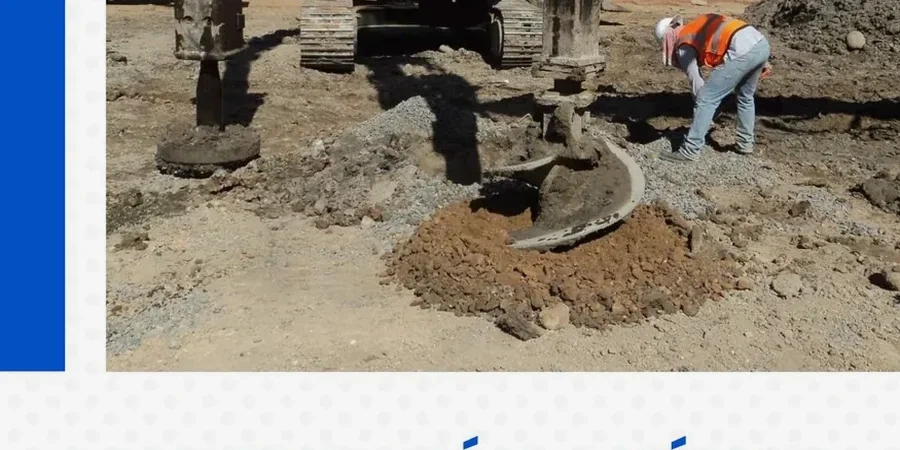
A six-story condominium proposed near the old industrial canal in Sault Ste Marie hit refusal on loose silty sand at just four meters. The structural loads required bearing pressures the native ground could not deliver without unacceptable settlement. That scenario, repeated across the low-lying parcels flanking the St. Marys River, is precisely where stone column design becomes the rational ground-improvement path. Rather than deep piling through compressible horizons, the design inserts compacted granular columns that densify the surrounding matrix and create a composite mass with markedly higher stiffness. Sault Ste Marie's post-glacial stratigraphy—lacustrine silts, pockets of organic clay, and occasional soft till—responds predictably to vibro-replacement when the column grid, diameter, and aggregate specification are tuned to in-situ properties. Laboratory grain-size data from boreholes along Queen Street inform the grain-size analysis that feeds directly into the settlement calculation.
Stone columns in Sault Ste Marie's silty matrix deliver both settlement control and radial drainage—two functions that deep foundations alone cannot provide.
Quick answers
What ground conditions in Sault Ste Marie are best suited for stone columns?
Stone columns perform well in the silty sands, soft silts, and low-plasticity clays common along the St. Marys River floodplain. They are less effective in highly organic soils with undrained shear strength below 15 kPa or in peat layers thicker than 1 meter, where excessive lateral confinement loss can occur.
How much does stone column design and installation cost in the Sault Ste Marie area?
Design and installation typically ranges from CA$2,040 to CA$7,160 depending on treatment depth, column spacing, and the number of QA/QC load tests required. A site-specific estimate is developed after review of the geotechnical baseline report and column count.
How is the design verified once the columns are installed?
Verification combines aggregate consumption records, column continuity logging during installation, and post-installation load testing. A zone load test on a representative column group is the preferred method because it captures the composite response of columns and inter-column soil under a rigid load plate.
Does the NBCC require a specific factor of safety for stone column design?
The NBCC does not prescribe a single factor but refers to the Canadian Foundation Engineering Manual, which recommends a minimum global factor of safety of 2.5 against bearing failure for static loads and a settlement-based serviceability check under the 1-in-50-year seismic event.