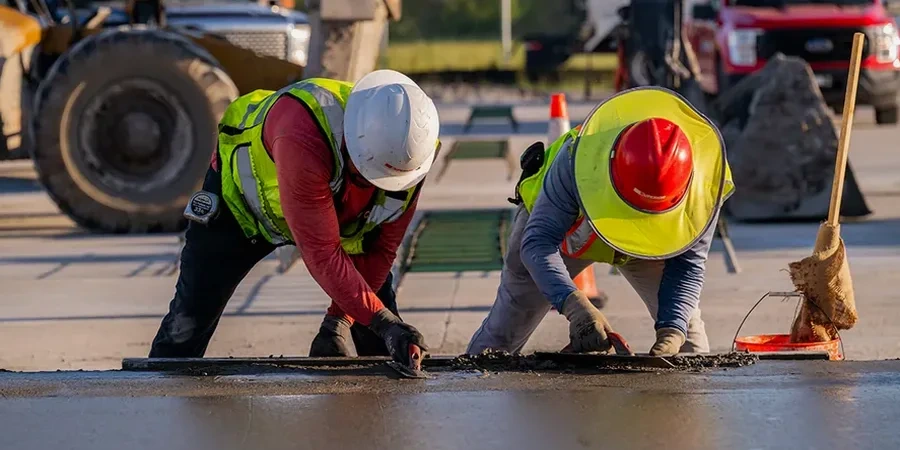
The soil profile on McNabb Street is nothing like what you find out by the airport on Airport Road. One sits on silty sand with decent drainage; the other rests on deep clay that holds moisture through every freeze-thaw cycle. Rigid pavement design in Sault Ste. Marie has to account for both—and for the 230+ cm of snow the city averages each winter. Our lab runs the full sequence: subgrade CBR, granular base gradation, and concrete cylinder breaks at 7 and 28 days. We don’t guess at slab thickness. We calculate it from the traffic load and the k-value of the subgrade, then verify with plate load testing when site conditions are uncertain. For heavy industrial access roads, we often pair concrete pavement with stone column ground improvement to bridge soft clay pockets before placing the base course.
A rigid pavement in Sault Ste. Marie fails from the bottom up—poor subgrade support and trapped moisture, not weak concrete.
How we work
The most common mistake we see local contractors make is pouring concrete directly on a graded subgrade without a proper granular base, then wondering why the slabs crack after the first spring thaw. Moisture trapped under the slab freezes, heaves, and the concrete—strong as it is in compression—fails in flexure. Our rigid pavement design process always starts with drainage: subgrade characterization, base thickness verification, and permeability assessment. We test concrete for air content per CSA A23.2-4C because Sault Ste. Marie winters demand 5-7% entrained air to resist freeze-thaw spalling. Joint spacing follows ACI 330.1 and is adjusted for slab thickness and dowel placement. When the pavement section includes poor subgrade, we recommend
CBR testing to calibrate the design modulus and confirm whether lime stabilization or a thicker aggregate base is needed before the concrete pour.
Concrete mix design is job-specific. We specify water-cement ratio, target slump, and aggregate type based on exposure class. For exterior slabs subject to de-icing salts, we move to a lower w/c ratio and require supplementary cementitious materials—slag or fly ash—to reduce permeability. Every batch gets slump, air content, and temperature checks at the truck chute, plus cylinder sets for compressive strength verification. The result is a pavement section that handles repeated axle loads and the worst of a Lake Superior winter.
Reference standards
CSA A23.1:19/A23.2:19 Concrete Materials and Methods of Concrete Construction, CSA A23.3 Design of Concrete Structures (pavement joint provisions), OPSS 350 Concrete Pavement (Ontario Provincial Standard Specification), OPSS 1010 Aggregates – Base, Subbase, Select Subgrade, ASTM D1196/D1196M Plate Load Test (k-value determination), MTO Pavement Design and Rehabilitation Manual (rigid pavement chapter)
Quick answers
What’s the difference between rigid and flexible pavement for a Sault Ste. Marie parking lot?
Rigid pavement uses a concrete slab as the primary load-bearing layer; flexible pavement uses asphalt over granular base. Here in Sault Ste. Marie, rigid tends to outperform on industrial lots and bus lanes because it resists rutting from heavy, slow-moving loads and handles freeze-thaw better when the subgrade is stable. The trade-off is higher initial cost and more demanding joint maintenance. For a standard commercial parking lot with cars and light trucks, flexible asphalt is often sufficient and cheaper to repair. We’ll give you the comparison based on your subgrade CBR and the expected axle loads.
How much does rigid pavement design and testing cost in Sault Ste. Marie?
For a typical industrial project in Sault Ste. Marie, the combined design, subgrade investigation, concrete mix development, and field QA/QC runs between CA$2,210 and CA$7,920 depending on slab area, number of test locations, and whether trial batches are required. A small truck dock slab with basic testing sits at the lower end; a full industrial yard with multiple mix designs and several days of field testing reaches the upper range. We carry out a fixed-fee proposal after reviewing the project drawings.
Why do concrete slabs in Sault Ste. Marie crack after the first winter?
Almost always it’s a combination of two things: poor subgrade drainage and insufficient air entrainment. Water saturates the subgrade in fall, freezes, heaves the slab unevenly, and the concrete—if it lacks 5-7% entrained air—spalls at the surface from freeze-thaw cycling. Joints that weren’t cut deep enough or soon enough also cause uncontrolled cracking. Our design addresses all three: a free-draining granular base, the right air void system, and a joint plan that gets sawed within 12 hours of finishing.
Can you do the concrete testing on site during the pour?
Yes, that’s standard for every rigid pavement project we handle in Sault Ste. Marie. We have a mobile lab setup and technicians who arrive with the first truck. They sample at the chute, run slump and air content on every truck or every 20 m³ (whichever is more frequent), cast cylinders for 7 and 28-day breaks, and monitor concrete temperature. If a load is out of spec on slump, we reject it before it goes into the forms. The field report is submitted the same day.