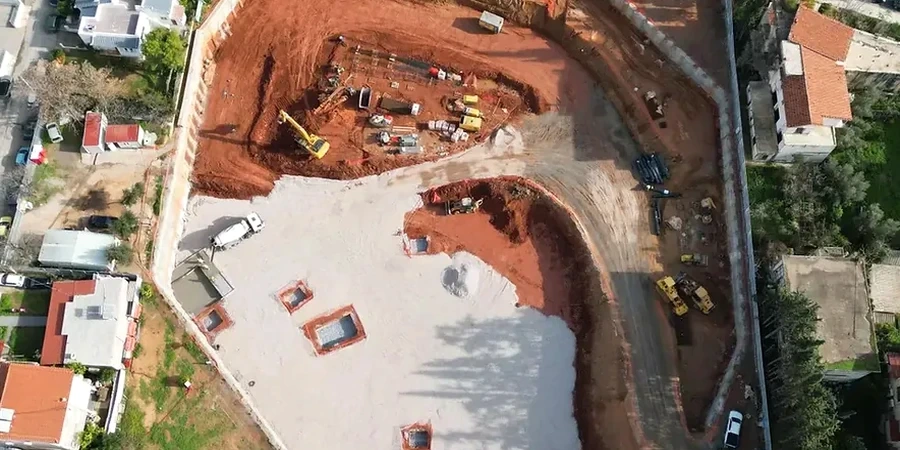
A developer broke ground for a 10-storey residential tower near Sault Ste. Marie's downtown core, adjacent to a century-old brick building on Queen Street East. The initial test pits revealed a chaotic sequence of glaciolacustrine silts over dense basal till, with groundwater appearing at just 2.8 metres depth. That scenario—tight urban site, sensitive neighbouring structures, and water-charged overburden—defines the challenge of deep excavation design in this city. Our laboratory team took those disturbed samples and ran a full suite of index and strength tests, feeding directly into the finite element model that sized the shoring system. In Sault Ste. Marie, where the Lake Superior clay belt and Precambrian bedrock control every cut, a CPT test provides the continuous stratigraphic profile that SPT alone cannot resolve, especially when identifying thin drainage layers that can destabilize a vertical face.
In Sault Ste. Marie's glaciolacustrine soils, we don't design for average conditions—we design for the spring thaw when groundwater peaks and apparent cohesion vanishes.
Quick answers
How much does a deep excavation design cost for a project in Sault Ste. Marie?
For a typical urban excavation in Sault Ste. Marie, the geotechnical design package—covering subsurface investigation planning, laboratory testing, shoring wall calculations, dewatering design, and sealed construction drawings—ranges from CA$3,040 to CA$11,830. The final cost depends on excavation depth, number of retained sides, proximity to the St. Marys River, and the complexity of the ground profile. A 6-metre cut with soldier piles will fall at the lower end; a 15-metre secant pile wall adjacent to a heritage structure requires substantially more analysis.
What laboratory tests are essential for designing a shoring system in Sault Ste. Marie's soils?
We consider consolidated-undrained (CU) triaxial tests with pore pressure measurement as the minimum for determining the effective stress strength envelope of the glaciolacustrine clays. Paired with one-dimensional consolidation tests to obtain the compression index and preconsolidation pressure, these allow us to model the undrained behaviour during the excavation and the drained settlement behind the wall. Atterberg limits and particle size distribution classify the material per ASTM D2487, while falling-head permeability tests on undisturbed samples refine the dewatering model.
What differentiates deep excavation design in Sault Ste. Marie from other Ontario cities?
The combination of varved glaciolacustrine deposits from glacial Lake Algonquin, the shallow depth to Precambrian bedrock across much of the city, and the extreme seasonal groundwater fluctuation sets Sault Ste. Marie apart. The bedrock surface is often irregular, creating pockets of trapped water that surcharge the shoring. Additionally, the winter construction season requires frost-protection measures and a design that accounts for the temporary strength gain and subsequent thaw weakening of the upper 1.8 metres of soil—a cycle less pronounced in southern Ontario cities.