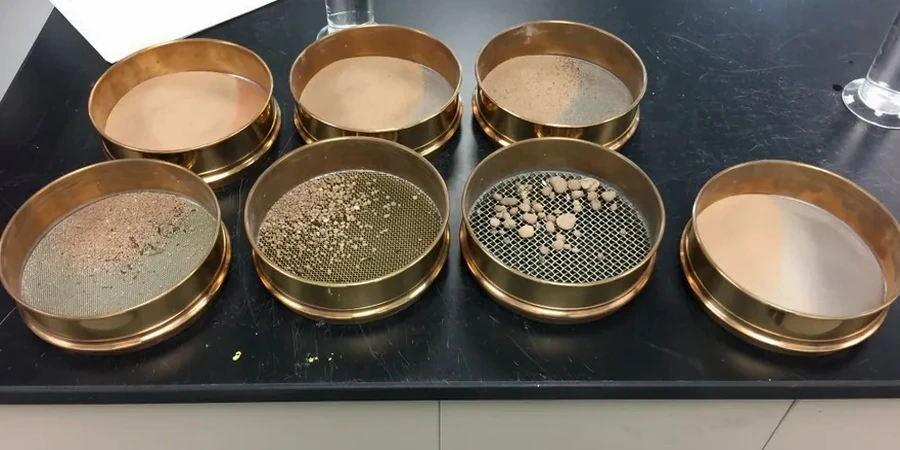
In Sault Ste Marie, contractors quickly learn that soil can shift from rocky glacial till to deep lacustrine clay within a single block. Guessing the gradation leads to bad drainage design or pavement that fails within two freeze-thaw cycles. A complete grain size analysis using both sieve and hydrometer methods removes that guesswork. The test covers everything from gravel down to the clay fraction. Our team processes samples from Algoma District projects weekly. We report the full particle-size distribution curve so engineers can classify the soil exactly. That data feeds directly into concrete aggregate selection, filter design, and frost-susceptibility checks under NBCC requirements. In Sault Ste Marie, you need a lab that understands the local glacial history. We run ASTM D422 and D6913 procedures with consistent precision, whether the sample comes from a residential lot near the river or a highway cut north of town.
A full sieve-plus-hydrometer curve reveals whether your fill material will drain or retain water through Sault Ste Marie's freeze-thaw cycles.
Quick answers
What does a combined sieve and hydrometer test cost in Sault Ste Marie?
A combined grain size analysis with full sieve stack plus hydrometer runs CA$180 to CA$260 per sample depending on whether we need to split the sample or run additional washes. A sieve-only analysis is CA$140 to CA$180. Turnaround is typically 3 to 5 business days. Rush service is available for an additional fee.
How much sample material do you need for the grain size analysis?
It depends on the maximum particle size. For fine-grained soils with particles under the No. 4 sieve, we need about 500 grams. For soils with gravel up to 19 mm, plan on 5 to 10 kg. If the material contains cobbles larger than 75 mm, we may need 30 to 50 kg to run the full coarse sieve stack. We can advise on sample size once you describe the material or send a photo.
Why do I need the hydrometer portion? Can't a sieve test tell me enough?
A sieve stack stops at the No. 200 sieve opening. It tells you the total percentage of material finer than 75 microns but not how much of that is silt versus clay. The hydrometer test separates the silt and clay fractions by measuring sedimentation rates. That distinction is critical for frost heave assessment, drainage design, and Atterberg limits correlation. In Sault Ste Marie, where freeze-thaw durability matters, skipping the hydrometer is a risk.
How do I interpret the D10, D30, and D60 values on the report?
D10 is the particle diameter at which 10% of the sample is finer. It is the effective grain size used in permeability estimates. D30 and D60 are the diameters at 30% and 60% passing. The ratio D60/D10 gives you the coefficient of uniformity Cu, which describes the range of particle sizes. D30 squared divided by D10 times D60 gives the coefficient of curvature Cc. A well-graded soil typically has Cu greater than 4 for gravel or greater than 6 for sand, and Cc between 1 and 3. We include these values and a brief interpretation note with every report.