← Home · Investigation

Exploratory Test Pits in Sault Ste Marie: Direct Subsurface Observation

Together, we solve the challenges of tomorrow.

LEARN MORE →

A contractor on Great Northern Road hit a pocket of saturated silt at two meters depth. The original borehole log missed it, but the excavation revealed the full picture. That is the core value of an exploratory test pit in Sault Ste Marie. You see the soil profile directly. No indirect interpretation of blow counts or cone resistance. The walls of the excavation expose layering, seepage zones, and cobble content in a way no other method can. Our field team logs the face, photographs the stratigraphy, and collects undisturbed block samples right at the contact zones. For projects near the St. Marys River or on the glaciofluvial terraces south of the city, this visual confirmation often resolves contradictions between geophysical data and borehole records. When the grain size distribution lab results come back from a test pit sample, there is zero doubt about which layer the material represents because the geologist stood in the pit and marked the boundary.

Direct observation of soil stratigraphy in an exploratory test pit eliminates the interpretation gap that exists with all indirect methods.

How we work

The most common mistake we see is treating a test pit like a simple backhoe hole. That approach misses the regulatory value. In Sault Ste Marie, an exploratory test pit must meet Ontario Regulation 213/91 documentation standards for construction dewatering or excess soil management. Our pits are logged by qualified field technicians who measure the depth to groundwater, describe soil texture following the Unified Soil Classification System, and photograph each face with a scale card. For footing design on the silty sand deposits common in the McNabb Street area, we excavate to at least 1.5 times the proposed footing width to observe the bearing stratum directly. The pit also allows in-situ density testing with a sand cone right at the bearing elevation. If the excavation encounters the Precambrian shield bedrock shallow, we clean the rock surface and document the jointing pattern and weathering grade before backfilling. This level of detail supports the geotechnical engineer's recommendations without ambiguity.
Exploratory Test Pits in Sault Ste Marie: Direct Subsurface Observation
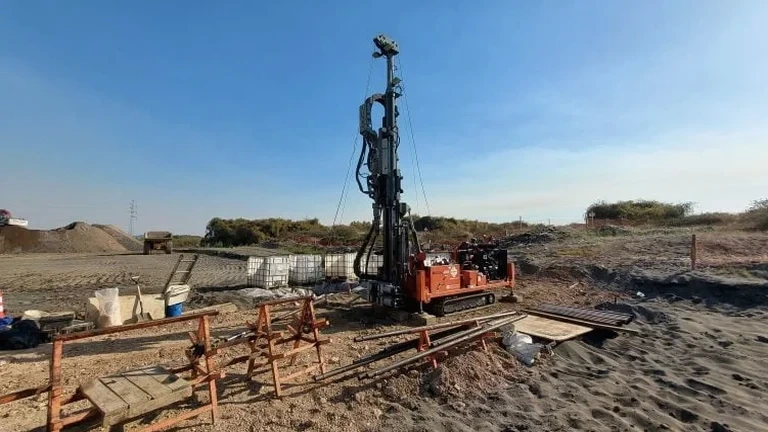
Technical reference image — Sault Ste Marie

Local considerations

Sault Ste Marie winters freeze the ground to over a meter deep, but spring thaw creates a perched water table in the upper silty soils that catches many excavation crews off guard. An exploratory test pit dug in late April will show groundwater conditions completely different from a pit excavated in August. The other regional hazard is the contact between the glaciofluvial sands and the underlying laminated clays. When a pit reaches this interface, the clay face can start slaking within hours if left unsupported. Our field protocols require immediate logging and sampling of these contact zones. If the pit must remain open overnight, we specify a standoff distance for equipment and install a sump pump to manage seepage. The visual evidence from the pit walls often reveals thin silt seams within the clay that act as drainage paths, information that a conventional borehole would likely miss.

Need a geotechnical assessment?

Reply within 24h.

Email: info@geotechnicalengineering.vip

Technical parameters

ParameterTypical value
Maximum excavation depth4.5 m (with shoring)
Standard pit dimensions2.4 m x 1.2 m (backhoe)
In-situ density testASTM D1556 sand cone method
Soil classification standardUnified Soil Classification System (USCS)
Groundwater observationDepth to free water surface recorded within 30 min of excavation
DocumentationPhotographic log, field vane shear, pocket penetrometer readings per O. Reg. 213/91

Other technical services

01

Standard Exploratory Test Pit

Backhoe excavation to 4.5 m, full stratigraphic log, USCS classification, groundwater measurement, digital photo log of all four faces, and in-situ density testing at bearing elevation. Suitable for foundation subgrade verification and utility trench assessment.

02

Advanced Sampling Test Pit

Everything in the standard package plus undisturbed block sampling of cohesive soils, Shelby tube sampling from pit floor, field vane shear testing at 0.5 m intervals, and laboratory testing coordination for shear strength and consolidation parameters.

Reference standards

Ontario Regulation 213/91 (Construction Dewatering and Excess Soil), CSA A23.3 (Concrete Design – reference for foundation bearing verification), ASTM D2488 (Visual-Manual Description of Soils), ASTM D1556 (Sand Cone Density Test), NBCC 2020 Part 4 (Structural Design – geotechnical input)

Frequently asked questions

How much does an exploratory test pit cost in Sault Ste Marie?

For a standard exploratory test pit excavated to depths between 2.5 and 4.5 meters in the Sault Ste Marie area, the cost typically ranges from CA$710 to CA$980. This includes backhoe mobilization, field technician time, stratigraphic logging, photographic documentation, and in-situ density testing. The final cost depends on access constraints, number of pits required, and whether shoring is necessary for deeper excavations.

What are the depth limits for a test pit in Sault Ste Marie soils?

The practical limit with a standard backhoe is about 4.5 meters. Below that, we need shoring or a stepped excavation, which increases the footprint and cost. In the sandy soils common around the Sault Ste Marie airport area, you might reach 5 meters with a benched excavation. If the water table is high or the pit encounters running sands, the maximum stable depth drops significantly.

Do I need a test pit if I already have borehole data?

A test pit complements borehole data. Boreholes give you a continuous vertical profile at one point, but a test pit exposes a continuous horizontal face. You can see lateral variability, identify thin silt seams that control drainage, and observe the true cobble content in glacial till. For critical foundation verification, the direct visual evidence from a test pit resolves ambiguities in the borehole log.
Location and service area

We serve projects in Sault Ste Marie and surrounding areas.

View larger map