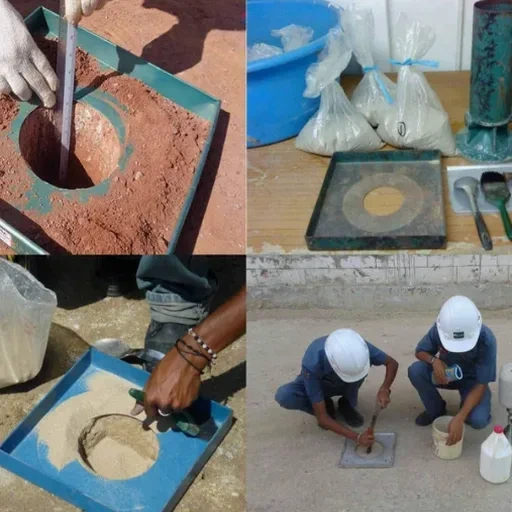
Compaction control in Sault Ste Marie must contend with a short construction season and the variable glacial deposits that dominate the local geology. The sand cone test, performed under ASTM D1556, remains the most direct field method to verify that placed fill meets the specified percentage of the modified Proctor maximum dry density. In our expertise working on projects from the International Bridge plaza to residential subdivisions near Finn Hill, we see consistent challenges with silty sand layers that lose moisture quickly during the warm weeks of July and August. The NBCC and CSA A23.3 require documented density records for structural fill beneath footings and slabs, and the sand cone provides a defensible, court-tested procedure that leaves a physical report for the geotechnical engineer of record. When subgrade conditions are borderline, we often pair the density test with a CBR assessment to confirm that the pavement structure will perform through freeze-thaw cycles that routinely push frost depth past 1.5 metres in this part of Ontario.
A sand cone test done right tells you whether the roller operator needs another pass or whether the fill is ready for the next lift — there is no grey area.
Regional considerations
A few seasons ago we were called to a commercial site off Second Line East where the contractor had placed nearly a metre of structural fill without a single density test. The owner was ready to pour grade beams, but the geotechnical report required 98 percent modified Proctor. We ran a grid of sand cone tests across the pad and found compaction values ranging from 82 to 91 percent — well below the threshold. The fill had been placed in lifts that were too thick, and the silty sand had dried out, preventing proper binding. The remediation involved re-excavating the upper 600 millimetres, remoistening the material with water trucks, and recompacting in controlled 200-millimetre lifts with continuous testing. The project delay cost three weeks of good weather. That case illustrates why the Ontario Building Code ties compaction verification directly to the geotechnical investigation: skipping the test shifts the entire risk onto the structural elements, which are far more expensive to fix than a failed density result caught during earthworks.
Reference standards
ASTM D1556: Standard Test Method for Density and Unit Weight of Soil in Place by Sand-Cone Method, CSA A23.2-14A: Field Density by the Sand-Cone Method, NBCC 2020: Part 4, Structural Design, referencing geotechnical site investigation requirements, Ontario Provincial Standard Specification (OPSS) 501: Compacting
Quick answers
How much does a sand cone density test cost in Sault Ste Marie?
A single sand cone test on a Sault Ste Marie site typically runs between CA$160 and CA$220, depending on the number of tests scheduled per mobilization and the travel distance from the lab. Reduced rates often apply when we perform six or more tests in a single visit.
How long does one sand cone test take on site?
Plan for roughly 20 to 30 minutes per test location. That includes excavating the hole through the full lift thickness, sealing the base plate, flowing the calibrated sand, recovering the excavated material, and running a field moisture content on the gas stove. We carry out the dry density and percent compaction number before we leave the test location.
Can the sand cone method be used on gravelly or coarse soils?
ASTM D1556 limits the sand cone method to soils with a maximum particle size of about 50 millimetres. When the fill contains abundant cobbles or oversized rock fragments, the test cavity becomes irregular and the Ottawa sand cannot reliably fill the void spaces. In those situations we recommend alternative methods such as a nuclear density gauge or a large-scale water replacement test, which we can arrange through the lab.